Chapter 21 — WorkBuddy as a GEO Expert
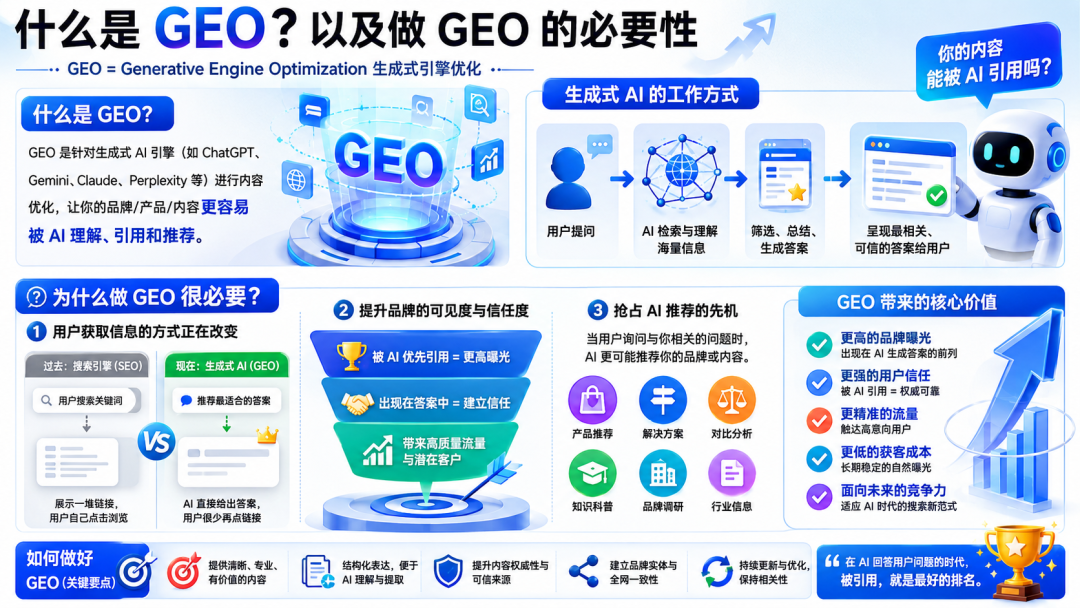
GEO is Generative Engine Optimization.
In the past, brand work mostly cared about SEO: when users searched a keyword in a search engine, could the official site, articles and media coverage rank up top. Now more and more users ask generative AIs directly — Yuanbao, DeepSeek, Doubao, Kimi: "which product suits me?", "what tools exist in a field?", "is this company reliable?" The brand's problem changes: are you in the AI's answer, is it accurate when it mentions you, and is there a trust basis when it recommends you.
What a GEO Diagnosis Solves
GEO isn't having AI write a brand advertorial; it answers a more basic question: in real user-question scenarios, is your brand understood, cited and recommended by AI.
| Question | What to look at | Example |
|---|---|---|
| Visibility | Whether the brand is mentioned in AI answers | User asks "is there desktop software that unifies multiple AI Agents" — is WeSight mentioned. |
| Accuracy | Whether AI's description of the brand is correct | Are function, supported platforms, target users, price, open-source status stated wrongly. |
| Competitive position | On the same question, whom AI gives the recommendation slot to | Competitors frequently recommended while your product barely appears. |
| Trust source | Whether AI can find credible material to back the answer | Do official site, GitHub, media coverage, self-media matrix and user reviews form a closed loop. |
| Action point | What to fix first after diagnosis | Fix official-site docs, optimize README, add a competitor-comparison page, handle negative sentiment. |
Pick the Right Expert First: The Brand GEO Diagnosis Expert
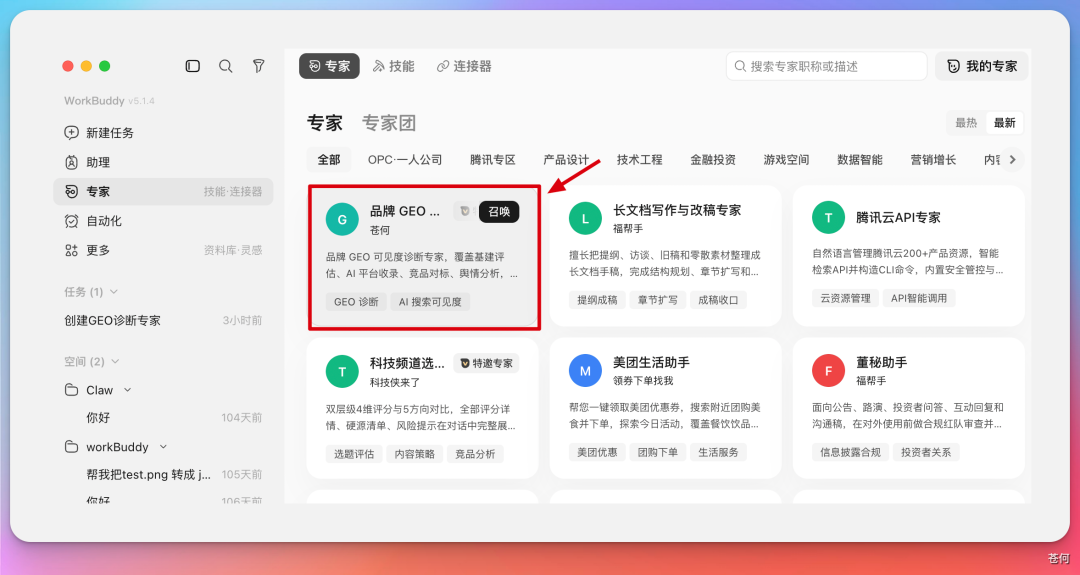
The GEO diagnosis Skill is listed on WorkBuddy's expert market as a directly summonable "Brand GEO Diagnosis Expert", with a packaged diagnosis flow: from brand input, question-set design, platform testing, to visibility, infrastructure, competitor, sentiment and roadmap output.
Who This Expert Suits
- Product teams: want to know the product's visibility in AI search, competitive pressure and content gaps.
- Enterprise brands: want to know whether the company is accurately recognized by AI and whether the official site and media material are credible enough.
- Personal IP / self-media: want to know whether their name, account and signature works are correctly recalled by AI.
- Market & growth teams: want to turn "publishing content" into a goal-driven, re-testable, evidence-backed GEO plan.
Recommended Input Material
| Input item | Why needed | Example |
|---|---|---|
| Official site / product page | As the first source of brand fact | Official site, product intro page, pricing page, help center. |
| Project address | Tech products need to prove activity and capability bounds | GitHub, open-source repo, changelog. |
| Official accounts | Let AI recognize authoritative publish channels | WeChat, Zhihu, Juejin, Xiaohongshu, Bilibili, Video Account. |
| Target users | The question set must start from real user intent | Developers, enterprise managers, content creators, procurement leads. |
| Competitor list | Judge who occupies the semantic recommendation slot | 2–5 known competitors or alternatives. |
GEO Diagnosis
GEO diagnosis can also be split into a stable workflow first. Don't start with "how's my GEO"; have the expert state the diagnosis scope, test questions and scoring definitions first.
flowchart LR
    A[Confirm brand & official material] --> B[Build a real-user question set]
    B --> C[Pick test platforms & sampling scope]
    C --> D[Record mention rate & answer accuracy]
    D --> E[Check official site, content matrix & authoritative sources]
    E --> F[Analyze competitors, inclusion & sentiment]
    F --> G[Generate report & 30/60/90-day action plan]
| Step | What WorkBuddy does | What the human confirms |
|---|---|---|
| 1 | Read the brand official site, project address and public material. | Which info is official fact, which is reference only. |
| 2 | Generate a set of real-user questions, not just test the brand name. | Whether these questions truly come from target users' search intent. |
| 3 | Test brand mentions across multiple AI platforms or search scenes. | Test platforms, sample count, whether signed in, test date. |
| 4 | Analyze AIVO, user profile, competitors, infrastructure, sentiment and inclusion. | Whether each score traces to samples and evidence. |
| 5 | Output an HTML / Feishu-doc report and an optimization roadmap. | Which actions first, which conclusions need human review. |
Prompt Example: Product GEO Diagnosis
Summon the "Brand GEO Diagnosis Expert" to diagnose WeSight's GEO situation.
Official material: official site, open-source project address, official accounts.
Target users: users who need to unify management of multiple AI Agents, desktop workflows and dev tools.
Known competitors: auto-identify from user questions first, then let me confirm.
Output the test question set, test platforms, sample count, scoring definitions and limitations first; execute after I confirm.
Final output: diagnosis overview, AIVO score, user profile, search visibility, infrastructure assessment, competitor analysis, inclusion effect, sentiment analysis and optimization roadmap.
Results that can't be repeatedly verified are marked "sample observation" — don't write as absolute fact.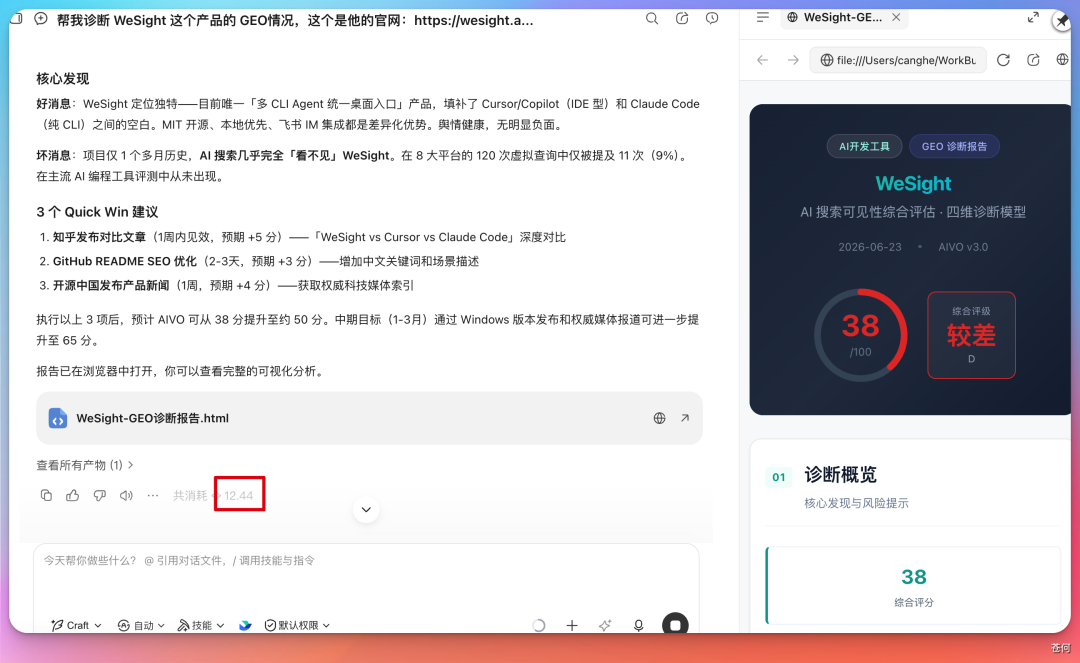
Result you get: not a "is the GEO good or not" one-liner, but a report that breaks down the problem. In the case, WeSight's issue wasn't a lack of product differentiation — in the test sample the AI-search visibility and competitor-comparison advantage were weak, dragging the composite score down.
Report Module 1: Diagnosis Overview and Risk Alerts
The overview gives operators a global call: how's the brand overall, what's the main risk, what to handle now. It shouldn't give just a score — it should explain where the score comes from.
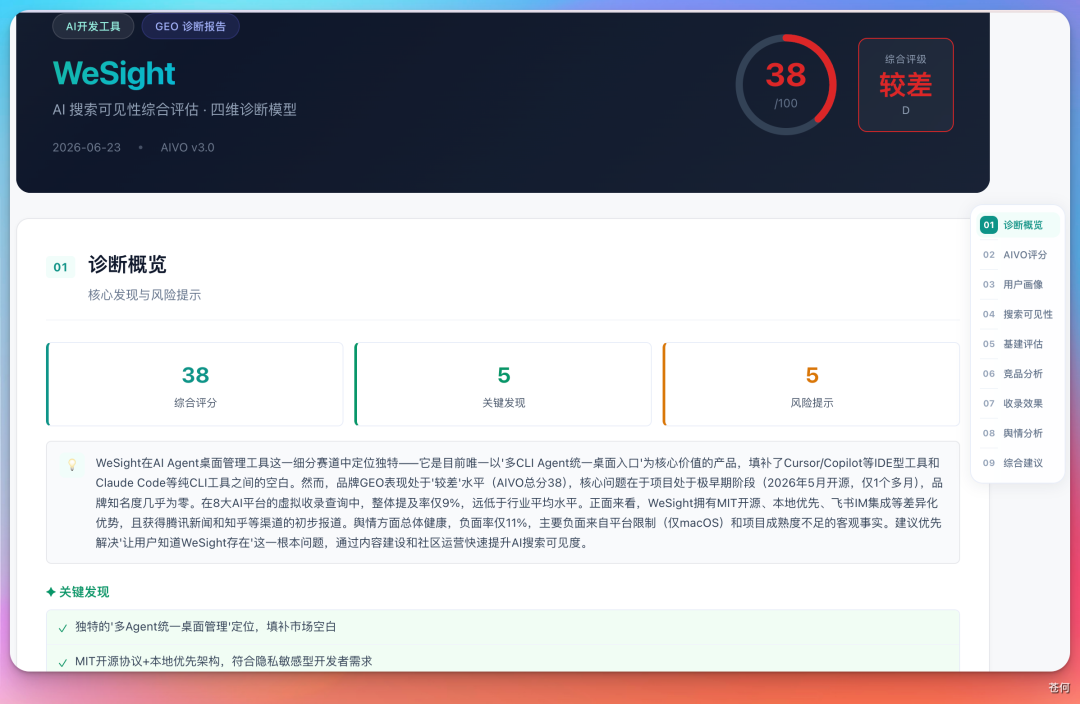
| What to look at in the overview | Why it matters | How to review |
|---|---|---|
| Composite score | Quick judge of current GEO baseline | Confirm scoring scope and test sample; don't treat one score as a permanent conclusion. |
| Key findings | Find the short-board most affecting the result | Each finding must trace to a specific platform, question and answer. |
| Risk alerts | Catch negative factors affecting recommendation early | Distinguish fact risk, content gap and model misunderstanding. |
For example, a product boundary like "WeSight only supports macOS Apple Silicon" — if the official site, README and external material don't explain it clearly, AI may attach a limit reminder when recommending, or even exclude it from some user needs.
Report Module 2: AIVO Score — See Where the Short-Board Is
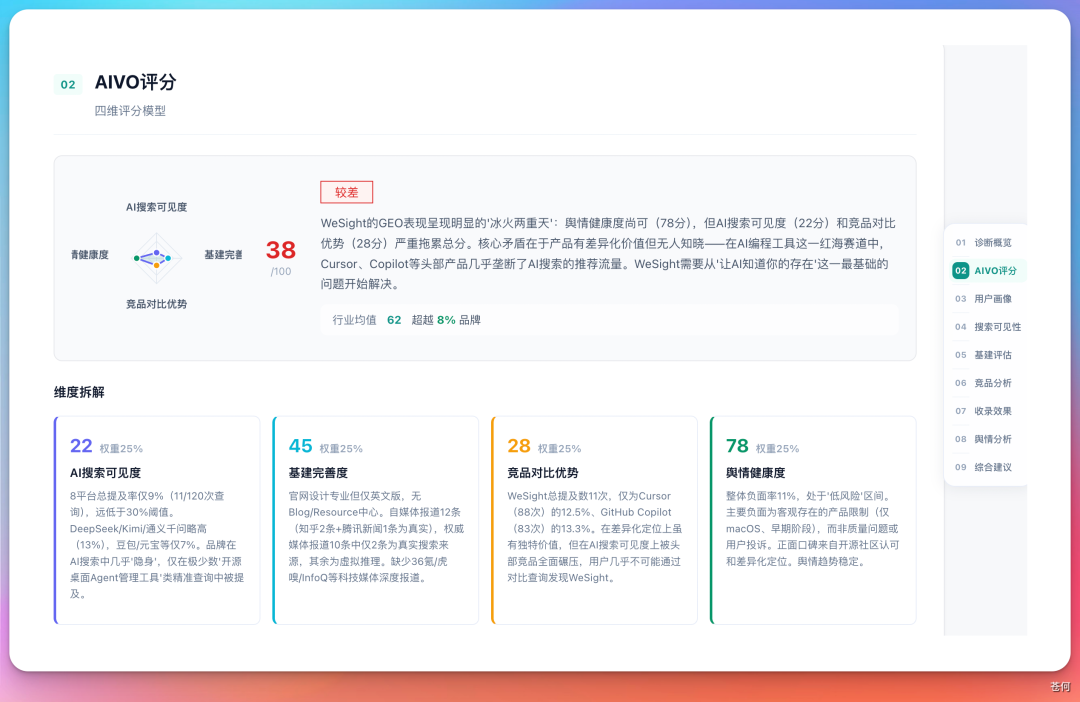
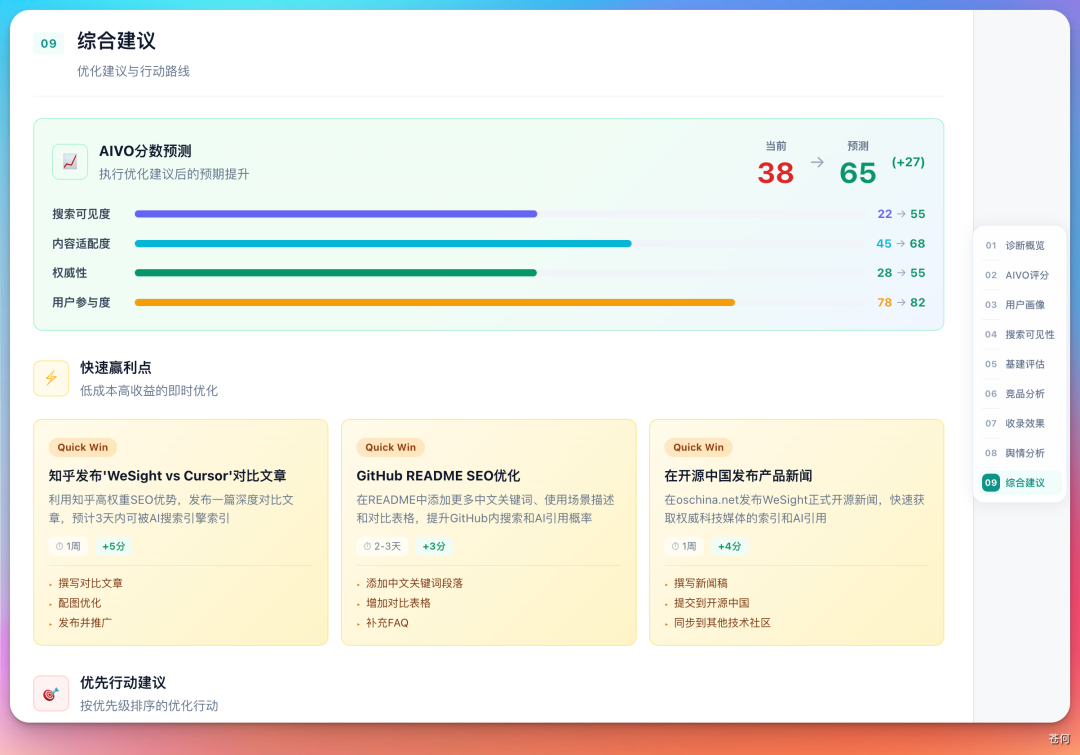
Split GEO into four dimensions: AI-search visibility, infrastructure completeness, competitor-comparison advantage, sentiment health. This split is more valuable than a single total — it tells you whether it's "no one mentions you", "someone mentions you but inaccurately", or "competitor material is stronger".
| Dimension | What it measures | What to do first when low |
|---|---|---|
| AI-search visibility | The rate and position the brand is mentioned when users ask related questions. | Add content pages, comparison pages and scenario pages for user questions. |
| Infrastructure completeness | Whether official site, official accounts, tech docs and authoritative sources are complete. | Fix official-site facts, unify names, add structured intros. |
| Competitor-comparison advantage | On the same query, whom AI more easily recommends. | Write differentiator, applicable bounds and trade-offs vs competitors. |
| Sentiment health | How external reviews, negative info and risk alerts affect recommendation. | Handle real problems; add official clarifications and credible third-party evidence. |
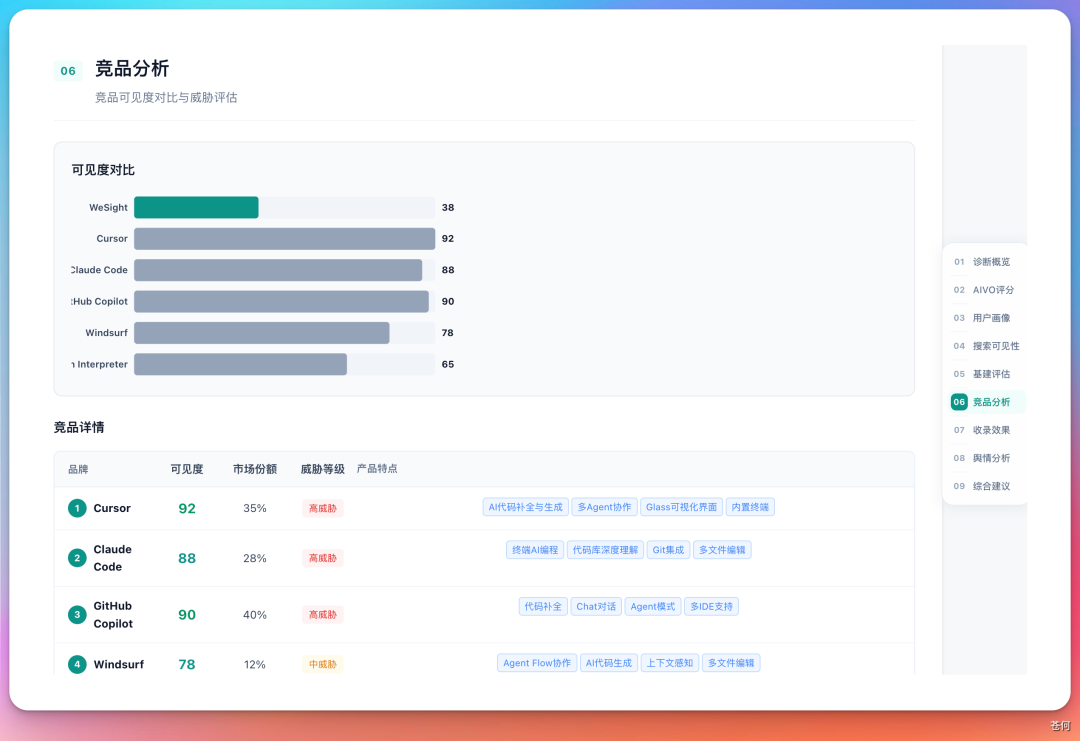
In the WeSight case, the composite was about 38; sentiment health was relatively good, but AI-search visibility and competitor-comparison advantage were weak. This shows the problem may not be the product itself, but a gap between "user-question semantics" and "brand content supply".
Report Module 3: User Profile and Intent-Funnel Drift
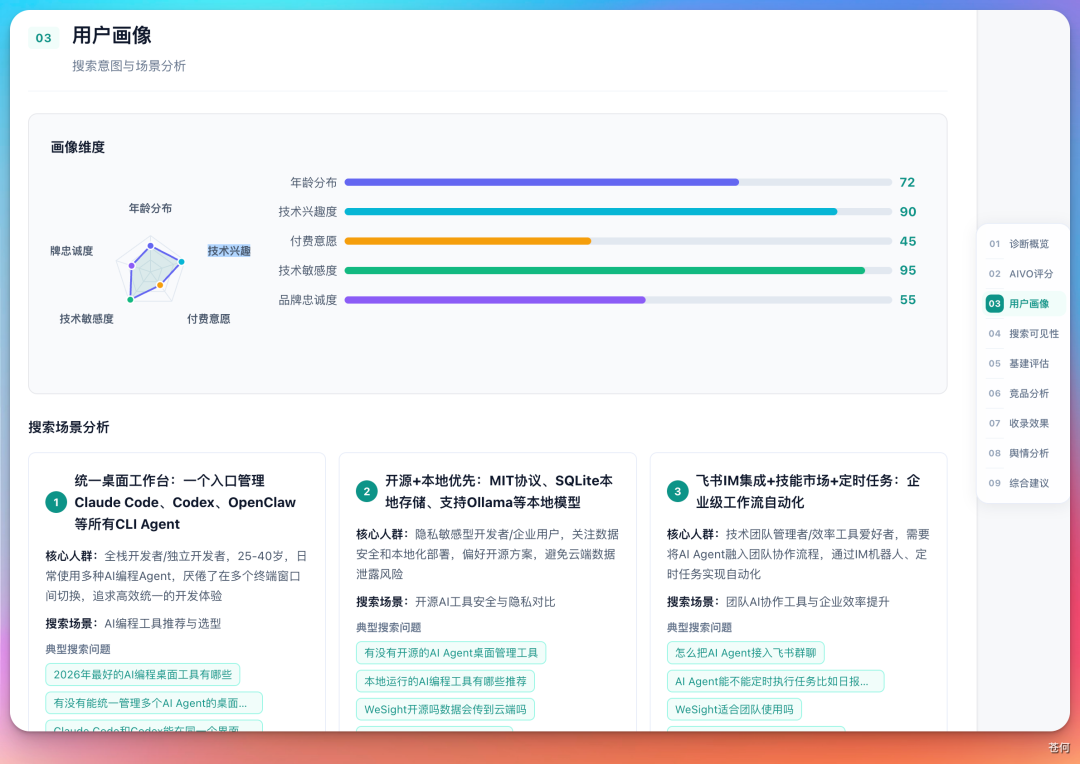
Many brands write content only for the selling points they want to express, but GEO cares more about how users really ask. In the WeChat case, the expert found users more easily ask "is there desktop software that can unify management of multiple AI Agents". This means users care about scenarios and tasks, and may not know your brand name.
Report Module 4: Search Visibility — Mention Rate Is the New Ranking
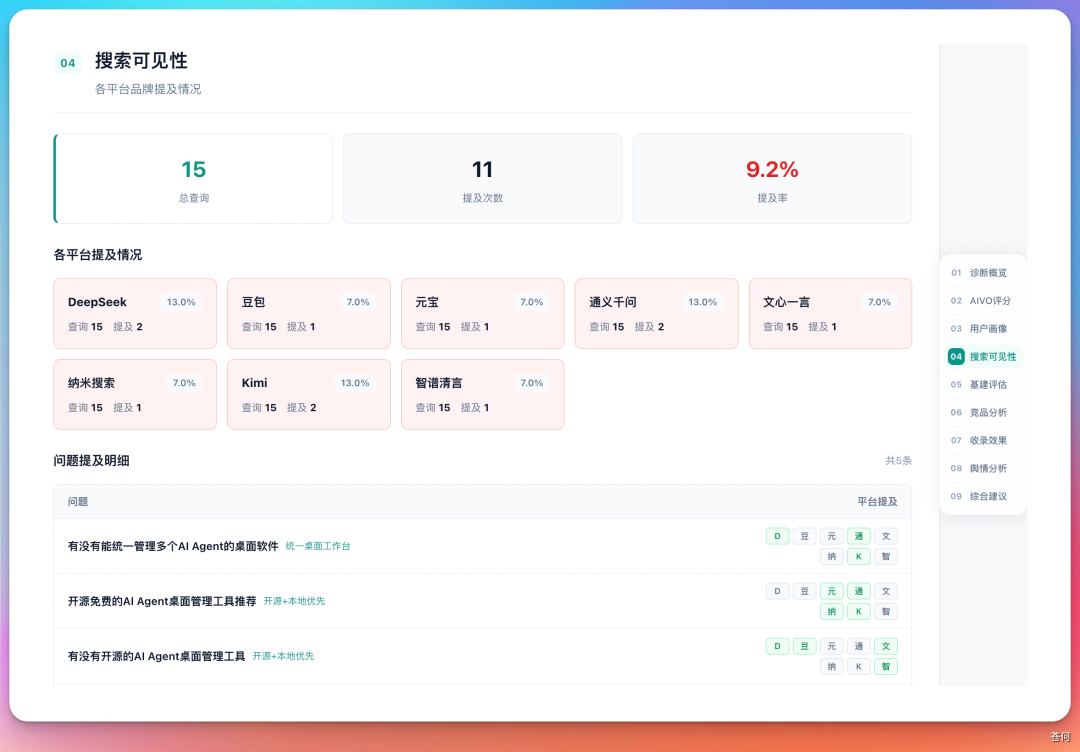
In traditional search, users at least see a page of links; in AI search, users often read only one answer. Whether the brand is mentioned, where, and whether it appears as a recommendation becomes the new "search ranking".
Report Module 5: Digital Infrastructure — Let AI Have Credible Material to Read First
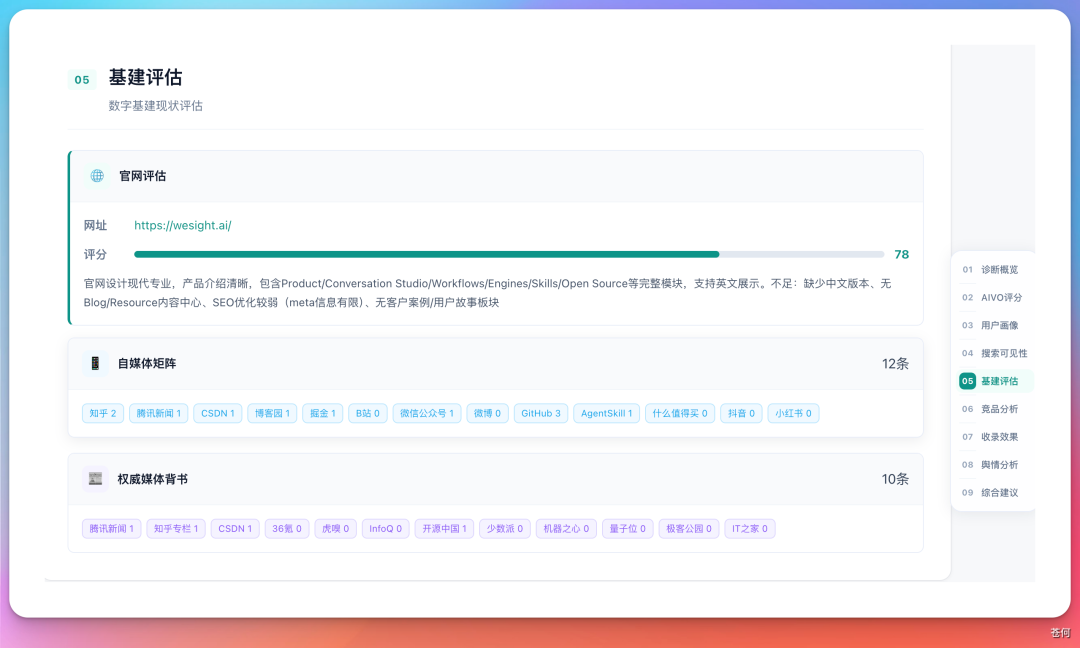
GEO isn't just "making noise". Generative AI needs citable, verifiable, mutually-corroborating credible sources. Split the infrastructure assessment into three: official-site assessment, self-media matrix, authoritative media endorsement.
Report Module 6: Competitor Analysis — Competing for Semantic Mindshare
GEO competitor analysis isn't just listing market competitors — it's seeing on the same user question whom AI gives the recommendation slot to. You and competitors compete not for web ranking, but for semantic mindshare.
Report Module 7: Inclusion Effect — Ultimately Whether You're in the AI Answer
Inclusion effect is GEO's outcome metric. The prior official site, content matrix, sentiment and competitor analysis all land on one question: are you in the AI answer.
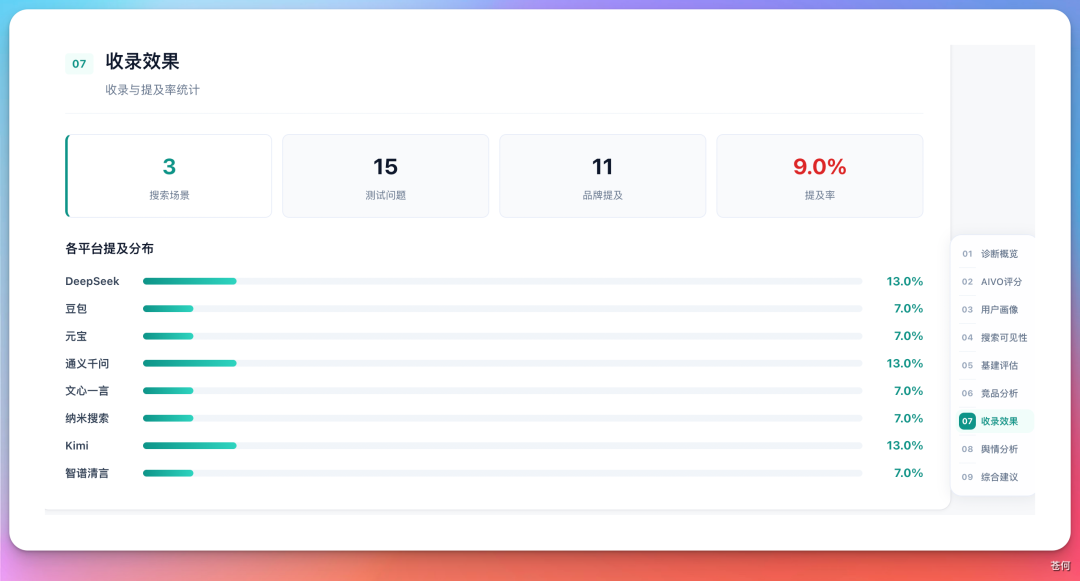
The easiest mistake here is testing only the brand name. The brand name being searchable doesn't mean you appear when users ask scenario questions. The right approach is to layer the questions:
- Brand-name questions: what is brand X, what's the official site, is it open-source.
- Category questions: what tools of a kind exist, for whom, how to choose.
- Scenario questions: I have a specific task — what product can solve it.
- Comparison questions: what's the difference between A and B, which suits a certain user.
Report Module 8: Sentiment Handling
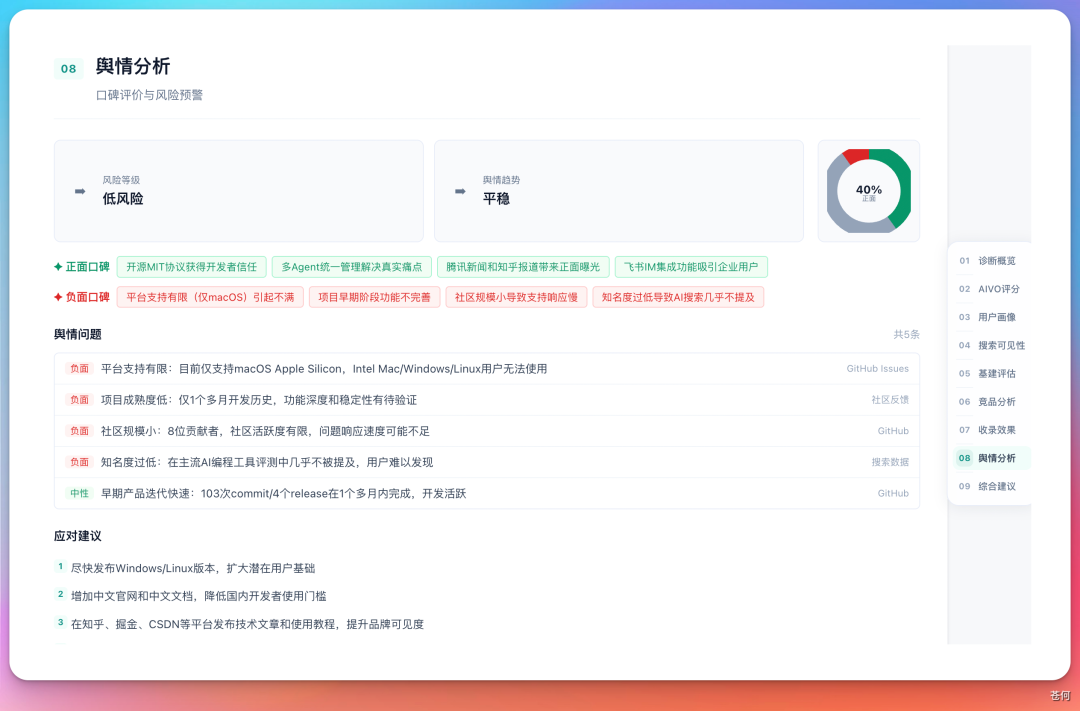
| Sentiment type | Handling | Notes |
|---|---|---|
| Real product issue | Fix the product first, then publicly note the fix progress. | Don't just suppress content. |
| Stale info | Update the latest facts on the official site and authoritative channels. | Let new material be clearly recognized by AI. |
| Misunderstanding or rumor | Correct with FAQ, clarification posts, third-party evidence. | Avoid emotional responses. |
| Competitive-comparison disadvantage | Clarify applicable bounds and differentiated scenarios. | Don't write every comparison as "I'm best". |
Personal IP Can Also Do GEO Diagnosis
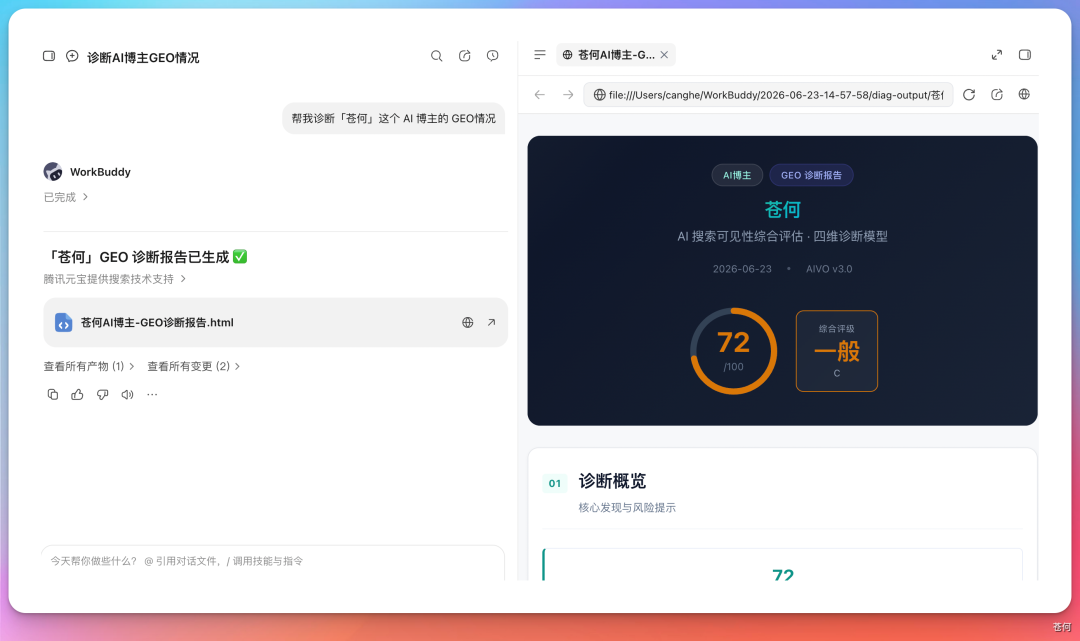
GEO isn't only for products and enterprises — it suits personal IP too. Diagnosing "Cang He" as a personal IP scored about 72, with extra search verification on Yuanbao.
What Personal-IP Diagnosis Must Extra-Note
- Identity disambiguation: many people share a name; you must provide location, occupation, signature works, official accounts.
- Platform scatter: WeChat, Zhihu, Xiaohongshu, Bilibili, Video Account info may be inconsistent.
- Signature works: AI needs to know your most important works, viewpoints and tags.
- Content positioning: personal IP isn't just "being searchable" — also how AI describes you.
Summon the "Brand GEO Diagnosis Expert" to diagnose my personal IP's GEO.
Name / nickname: ____.
Identity disambiguation: location, occupation, company or org, signature works, official accounts.
Target questions: on which topics do I want to be correctly mentioned by AI when users ask?
Test brand-name questions, domain questions, work questions and comparison questions.
Output: visibility, identity accuracy, signature-work recognition, same-name confusion risk, content gaps and 30-day optimization advice.
Enterprise Brand Diagnosis — Don't Do GEO for GEO's Sake
The easiest way enterprises go wrong with GEO: before diagnosing, they start bulk-buying content,铺 channels, farming exposure. The WeChat case notes that when diagnosing an enterprise, what really matters is first knowing what the brand looks like in AI's eyes: is it mentioned, is it misunderstood, where's the risk, why competitors are more easily recommended.
Key Checks for Enterprise Brands
| Check item | Key question | Common action |
|---|---|---|
| Brand basic facts | Who is the company, what does it do, whom does it serve, what's the core advantage. | Unify expression across official site, wiki, media posts, product pages. |
| Business scenarios | On which business questions should you appear. | Add scenario pages, solution pages, industry cases. |
| Credible endorsement | Are there customer cases, media coverage, industry reviews. | Build a citable public-material matrix. |
| Negatives & risks | Will AI mention negative, stale or wrong info. | Handle real problems; publish fact clarifications and update notes. |
From Diagnosis to Action: Don't Chase a One-Off High Score
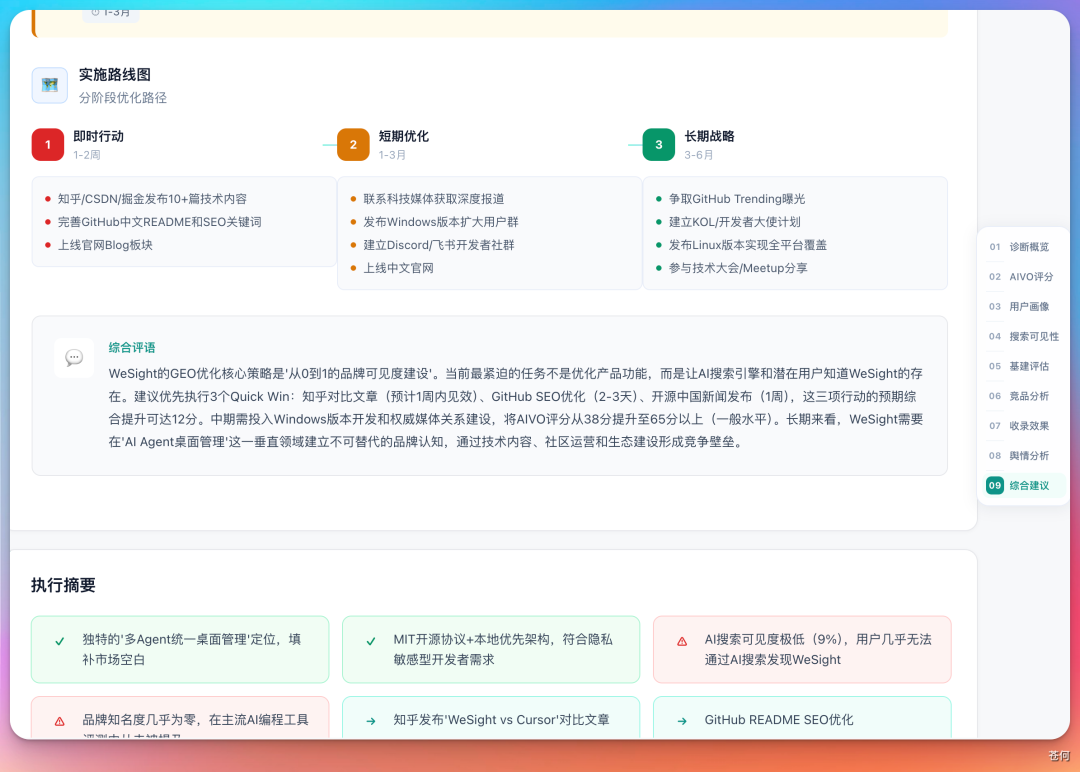
A GEO report that can't turn into action is just a pretty dashboard. Give quick wins, priority actions and a phased roadmap — e.g. close GEO-exposure gaps, handle sentiment, optimize credible sources.
| Phase | Priority action | Re-test method |
|---|---|---|
| 30 days | Fix names, positioning, function bounds and stale info on official site, README, official accounts. | Re-test brand-name questions and core scenario questions; check answer accuracy. |
| 60 days | Add scenario, comparison, case and FAQ pages matching real user queries. | Re-test category and scenario questions; observe mention-rate change. |
| 90 days | Build external credible sources: media coverage, customer cases, community discussion, industry viewpoints. | Check citation-source diversity, competitor recommendation slots and sentiment-risk change. |